Security Camera Low-Light Choices: Color-at-Night vs IR – Selection Guide
By Justin C., Video Security System Specialist — A2Z Security Cameras
Last updated: January 22, 2026
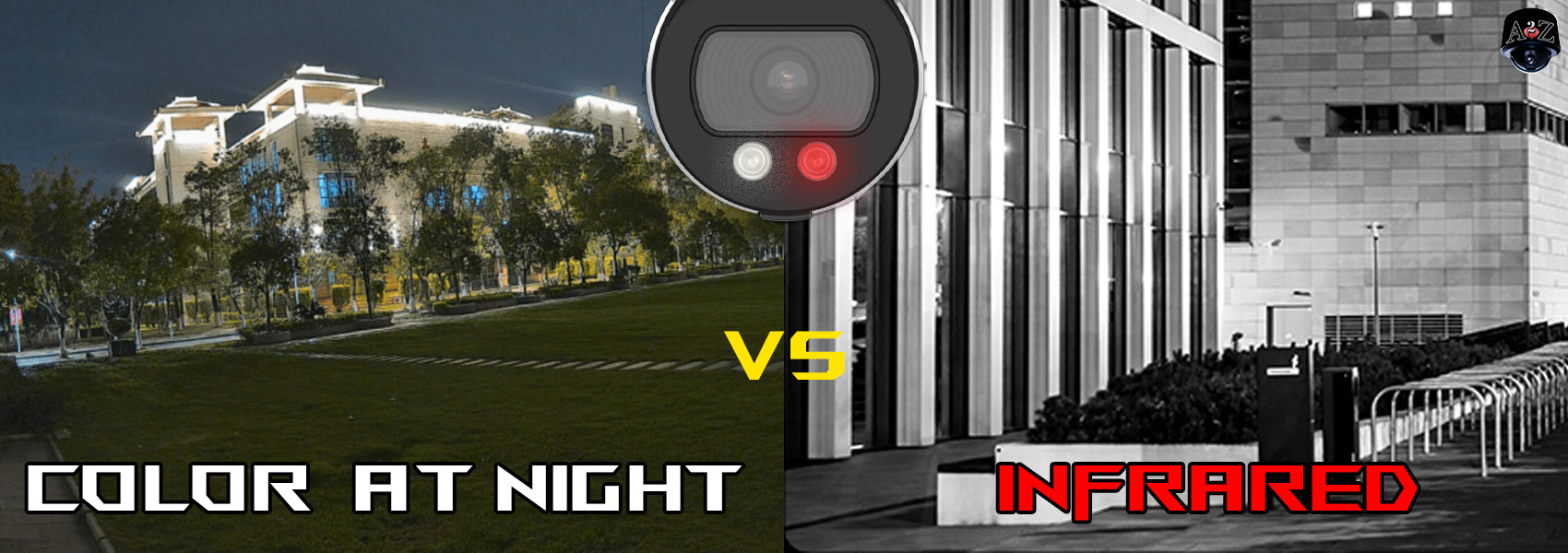
When the sun drops, image quality stops being “just a sensor problem” and becomes a strategy choice: keep color by leaning on ambient light or controlled white-light fill, or switch to IR for crisp monochrome detail in darkness. Whether you’re deploying modern IP security cameras or working with legacy CCTV cameras, the night decision usually comes down to color-at-night vs IR at the moment that matters. This guide helps you choose correctly for evidence—not aesthetics—with a practical decision tree, power/total cost of ownership considerations, and field-tested recommendations for common surveillance scenes. For WDR and broader lighting theory/tuning, see the companion lighting guide linked below in Next Steps.
What counts as “success” at night?
Start by defining your capture point (where the evidence has to be clear): the task (face or plate), the distance, and the motion you must freeze. Night scenes fail when security cameras chase brightness by slowing the shutter too much or over-smoothing noise—resulting in frames that look “fine paused” but fall apart during the moment you actually need.
Use these evidence-safe shutter-speed guardrails at the capture point:
- People/face detail: aim for ≥ 1/60–1/100 s
- Vehicle plates: aim for ≥ 1/250–1/500 s (often with a dedicated LPR/LPC license-plate camera)
If your chosen approach can’t hold these minimum evidence-safe shutter speeds without ugly gain/noise or heavy smear, it’s the wrong strategy—even if the scene looks bright.
Why “low-light color” can be misleading (slow shutter vs modern low-light)
This is the key concept that separates real-world evidence capture from “marketing color” in night surveillance.
Digital slow shutter / Sens-Up (legacy and low-cost technique)
Older low-light “color” modes often rely on digital slow shutter (Sens-Up / slow shutter / frame integration). The camera holds exposure longer (or combines frames) to raise brightness. It can work for static scenes, but it trades away what matters in security evidence:
- Motion blur/ghosting: faces smear, hands blur, plates become unreadable
- Lower effective FPS: movement can “jump” between frames
- Misleading confidence: the image looks bright until something moves
Slow shutter can be acceptable for slow, controlled scenes—but it’s a poor default for security evidence.
Modern low-light improvements (what actually helps)
Today’s better “color-at-night” results come less from slowing the shutter and more from improving how much light reaches the sensor and how cleanly it’s processed:
- Lens aperture (f-number): A lower f-number (wider aperture) gathers more light without sacrificing shutter speed.
- Sensor size & pixel design: Larger sensors (and modern pixel architectures) often deliver cleaner images in low light, helping you keep faster shutters at the same scene brightness.
- Modern sensors + image processing: Newer camera processing can hold detail better than older designs—but only if you control shutter, gain, and noise reduction.
Bottom line: If you’re getting “color” only by slowing the shutter past minimum evidence-safe shutter speeds, you’re not improving security—you’re just making a brighter blur.
The low-light decision tree
Use this decision tree for most security camera surveillance installs—homes, businesses, parking areas, gates, and perimeters.
1) Is reliable ambient light present at the capture point?
- Yes: Color-at-night may be viable → go to (2).
- No: Default to IR first (or thermal for detection, then use a standard camera to identify once motion is detected), then consider visible light options.
2) How fast is motion at the capture point?
- Pedestrians/slow movement (< ~1.5 m/s): Color-at-night can work if you can keep ≥ 1/60–1/100 s without extreme gain or heavy noise reduction.
- Vehicles/plates: If you can’t hold ≥ 1/250–1/500 s cleanly, use IR with a dedicated plate strategy or add tight, local white fill at the capture zone.
3) Policy / neighbors / wildlife constraints?
- No white light allowed / dark-sky / sensitive area: Choose IR (850 nm for reach; 940 nm for more covert operation).
- White light allowed with shielding: Color-at-night with small, local fills aimed at the subject—not the whole property.
4) Power/total cost constraints (solar, batteries, limited power)?
- Tight power budget: IR is usually more energy-efficient than broad white light.
- Mains power or smart motion lighting: Either approach; pick based on evidence quality and compliance.
5) Form-factor realities at the mount?
- Under soffits/eaves: Turrets reduce IR bounce; domes need careful placement or offsets.
- High bug pressure: Separate the light from the lens (stand-alone IR or off-axis white fill).
Color-at-Night (pros, cons, when to choose)
Why choose it: Color adds story—clothing hues, vehicle paint, object recognition—and can help operators and investigators interpret a scene faster. For many IP cameras designed for low-light, color-at-night can be excellent when ambient light is stable (or you can add controlled, shielded fill).
Success checklist - Ambient light is stable, or you can add low-glare local white light near the subject.
- You can maintain minimum evidence-safe shutter speeds ≥ 1/60–1/100 s without extreme gain.
- Noise reduction is light (avoid waxy faces or smeared edges).
- Fixtures have good color accuracy (CRI) if color accuracy matters (jacket hue, vehicle color).
Limitations - If light drops, the camera may slow shutter (blur) or push gain (noise).
- White-light compliance: neighbors, dark-sky rules, wildlife concerns.
- Energy cost if you flood large areas all night (mitigate with motion/dimming and localized fills).
IR (pros, cons, when to choose)
Why choose it: IR delivers crisp monochrome detail in truly dark scenes—often with less spill light onto neighbors’ property and lower power draw. With 850 nm you get more reach; with 940 nm you get more covert operation (usually with shorter range). For many CCTV and IP security camera installs, IR is the most consistent way to hold minimum evidence-safe shutter speeds at night.
Success checklist - Beam angle ≈ lens field of view (or slightly wider) to avoid hot spots and dark shoulders.
- Prefer turrets under eaves; avoid dome bubble reflections.
- Consider stand-alone IR so you can aim light and lens independently (reduces bugs/halos). (Browse IR / White Light LED Illuminators)
Limitations - No color—excellent for faces/plates, less helpful for identifying clothing or vehicle color.
- 940 nm range penalty; you may need more emitters or closer placement.
Total cost & power: which costs less to run?
- IR path: Typically lower watts for the same “evidence at target,” especially with 850 nm. Smart IR + motion/event recording helps in remote/solar builds.
- Color + white-light path: Costs more if you flood large areas; local fills near the capture point can be surprisingly efficient. Use motion or time-based dimming to reduce duty cycle.
Rule of thumb: If you can localize white light to the capture point, color’s incremental power cost is often small. If you must light a large area continuously, IR usually wins on energy and neighbor relations.
Scene archetypes & our recommendation
Glass vestibule (faces @ 8–20 ft)
- Pick: Color-at-night with small white fill; enforce ≥ 1/60–1/100 s shutter.
- Why: Natural skin tones improve recognition and interpretation.
- Fallback: If fills aren’t allowed, use IR + turret and manage glass angles to reduce bounce.
Parking lot (people + vehicles @ 20–80 ft)
- Pick: Color-at-night anchored by existing poles, plus local fills on lanes of interest.
- Why: Operator triage benefits from color; pedestrian motion is manageable.
- Fallback: IR schedules after close to save power and reduce complaints.
Gate/drive-through plates (5–30 mph)
- Pick: IR with a dedicated license-plate camera strategy and shutter ≥ 1/250–1/500 s; add small white fill at stop bars if you need mixed targets.
- Why: Plates demand short exposure and controlled angles.
- Fallback: Color can work only with tight fill light and genuinely slow traffic.
Perimeter fence, neighbors nearby
- Pick: IR (850 nm) with turrets; consider 940 nm if emitter glow is an issue.
- Why: Minimal spill light, consistent detail in dark.
Remote/solar camera pods
- Pick: IR + motion/event-first strategy; keep illumination near the capture area only.
- Why: Power budget and reliability.
Form-factor tips that influence the choice
- Turret vs dome under eaves: Turret wins for IR; domes often introduce bounce/snow unless offset forward.
- Bullets stay cleaner in rain and are easier to service; good for either approach.
- Panoramics want even lighting if you choose color; IR can work but uneven beams may emphasize stitching seams.
Evidence-safe shutter-speed guardrails (don’t break these)
- People: ≥ 1/60–1/100 s
- Plates: ≥ 1/250–1/500 s
- Avoid “pretty blur”: if color requires slow shutter, it’s not evidence color.
- Don’t let noise reduction smear fine detail—fix light/exposure first, then apply mild noise reduction.
- Slow shutter reduces effective FPS and can cause missed action frames.
- With IR, avoid overly narrow beams that hot-spot faces/plates; with color, avoid wide floods that create glare and complaints.
Quick comparison (color-at-night vs. IR)
| Factor | Color-at-Night | IR (850nm/940nm) |
|---|---|---|
| Evidence style | Color detail (hues, clothing) | High-contrast monochrome |
| Light requirement | Needs ambient or local white fill | No visible light needed |
| Motion tolerance | Good if minimum shutter speeds maintained | Excellent; short shutters are easier |
| Neighbor compliance | Potential light spill | Covert-friendly (esp. 940 nm) |
| Power budget | Higher if flooding large areas | Lower, event-friendly |
| Bugs/halos | Fewer if white light off-axis | Manage with off-axis IR / stand-alone |
Spec checklist (copy/paste)
- Strategy by scene: Color-at-night / IR 850 / IR 940
- Evidence target: face / plate, capture distance, minimum evidence-safe shutter speeds
- Exposure: minimum shutter speed, gain ceiling, noise reduction strength (avoid smear)
- Lens & sensor: aperture (f-number), sensor size considerations for low-light performance
- Lighting: ambient sources present? need local white fill (color temperature (CCT) / color accuracy (CRI), cutoff/shielding)?
- IR: integrated vs stand-alone, beam angle vs lens FOV, mount offset, bug mitigation
- Compliance: neighbor sightlines, dark-sky policy, wildlife concerns
- Power plan: continuous vs motion schedule; motion/event-first strategy for remote sites
Next Steps
- Browse categories: Security Cameras | IP Network Security Cameras | CCTV Security Cameras | IR / White Light LED Illuminators
- Foundations & tuning: Lighting for Security Cameras: WDR, IR, Color-at-Night & Supplemental Lighting
- Zero-light strategies: Thermal IR Security Cameras for Zero-Light Surveillance
- Storage planning: Security Camera Storage Options