
Security Camera Types & Form Factors: Bullet vs Dome vs Turret vs Fisheye vs PTZ — How to Choose
By Justin C., Video Security System Specialist — A2Z Security Cameras
Last updated: January 22, 2026
Security camera “shapes” aren’t just aesthetic—they evolved from function and real-world demands. While shape alone doesn’t decide what holds up in the field, it can strongly influence results. Because lines blur between “types” and “form factors” (with plenty of subclasses), there are few absolutes beyond specs and purpose.
What matters is the outcome. Objectives like observation, detection, tracking, or the level of evidence you must capture should take priority over shape—while recognizing that form factor can affect those outcomes in practical ways. Start with evidence standards (what must be provable), work backward into pixel density and lens needs, and only then pick the form factor that will survive the mounting location, lighting, and abuse the environment may present.
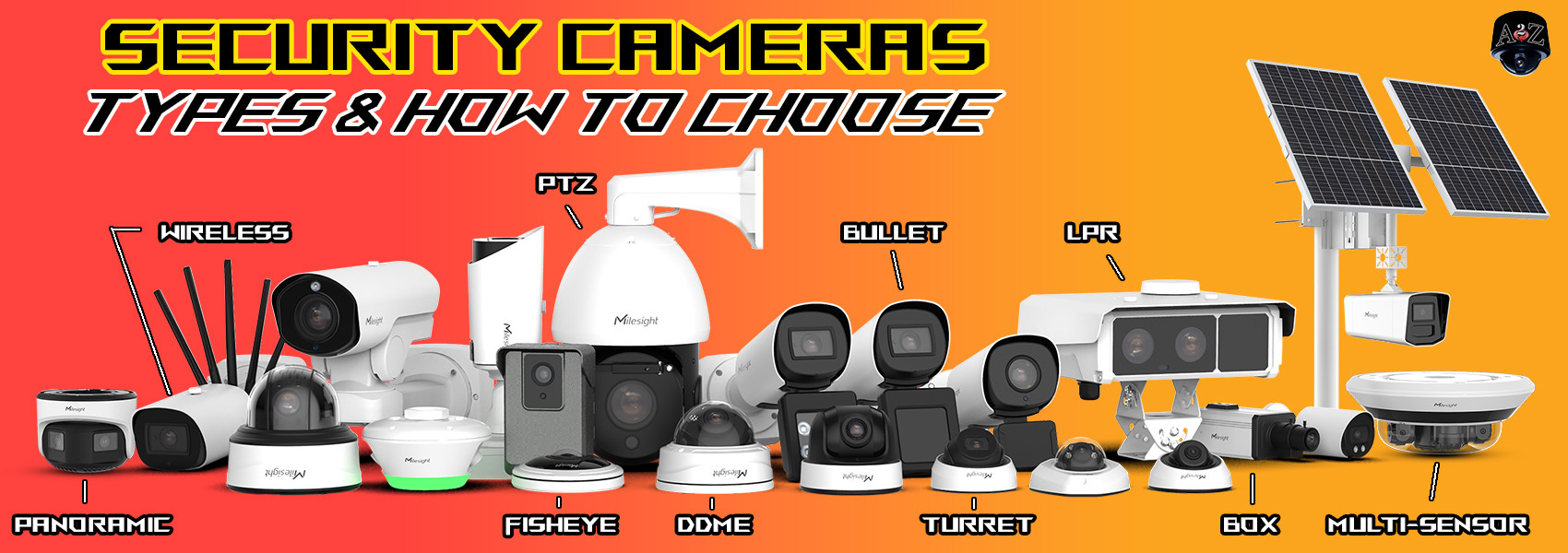
This guide covers the big five—bullet, dome, turret, fisheye/360°, and PTZ—and where multi-sensor (panoramic & directional), thermal, LPR/LPC, and mobile/compact or semi-covert options fit. It’s written to be used: practical pros/cons, field-tested tips, and quick references you can plug into a design or RFP.
How to use this guide (30 seconds)
(1) Define the evidence standard (detection/recognition/ID) at specific proof points.
(2) Size pixels + shutter + lens to hit it.
(3) Pick the form factor that will mount cleanly, stay clean at night, and survive the site.
Evidence tiers (quick reference)
Outcome Typical PPF/PPM Shutter floor (guide) Notes Detection ~20–30 PPF (65–100 PPM) ≥ 1/60 s “Someone is there.” Recognition ~40–60 PPF (130–200 PPM) ≥ 1/60–1/100 s Person vs. vehicle; recurring subject recognition. Identification ~80–120 PPF (260–400 PPM) Faces ≥ 1/60–1/100 s; Plates ≥ 1/250–1/500 s Proof of who/what exactly.
Names: “Form factors” (bullet, dome, turret, fisheye, PTZ, multi-sensor) describe shapes; “types” (thermal, LPR, explosion-protected, covert, mobile, rugged) describe roles/environments. They overlap; we use names pragmatically.
How to decide the “right” shape
Start with core objectives like proof points—the exact places you must capture faces or plates (entry doors, gate stop bars, drive lanes, registers). Measure the distance, note the angle (vertical and horizontal), and confirm mounting height. Set a PPF/PPM target, then choose the resolution, focal length, and position that achieve it. This clarifies what the camera’s core capabilities must provide.
Next, choose camera locations (perimeter and interior) that maintain the required evidence level while minimizing glare and tamper risk. Only then should you shortlist plausible form factors (bullet, dome, turret, multi-sensor, PTZ, or other) based on what will mount cleanly, stay clean at night, and survive the site—and then dive deeper as needed on specifics like whether PTZ or panoramic/multi-sensor better serves that scene.
Finally, as budget allows, add coverage cameras for observation/detection to fill gaps and improve situational awareness during an event.
Per-camera type common recurring factors
- Lighting reality. Backlit glass or docks demand True WDR and careful angles. Soffits and glossy paint can punish domes at night; bullets or turrets can also suffer reflections if standoff is poor. Low-ambient scenes may need IR, color-at-night with added light, or thermal; each path introduces challenges (IR bounce, glare, thermal near exhaust). Match the view to light distribution and avoid bright sources shining into the lens.
- Vandalism & reach. If hands can reach the camera, IK10 domes or protected mounts reduce tamper headaches. In exposed yards, bullets deter more visibly.
- Operational model. If no one is driving cameras, a single PTZ is not a coverage plan. Use fixed or multi-sensor for continuous recording and treat PTZ as an incident/active-use tool.
- Mounting & service. Choose junction boxes, wall arms, or pendant drops that fit the surface and keep cable connections protected and accessible.
- Environment. Extreme cold/heat or corrosive conditions narrow choices. Domes or bullets often have more accessory options (heaters, blowers, wipers) for these scenarios.
The breakdown: the major form factors (and what they’re best at)
Now that you’ve anchored the job around proof points, pixel density, and mounting realities, here’s the practical “field guide” breakdown of the most popular form factors found in modern surveillance and security camera systems. Use each section to shortlist what fits the location—then confirm the specs (lens range, WDR, low-light strategy, vandal rating) before you commit.
Bullet — Perimeter reach and visible deterrence
Bullets are cameras with a cylindrical body style, commonly mounted higher on exterior walls. You’ll see them along walkways, driveways, fences, lots, and docks, to name a few. They’re favored for all-in-one designs that often don’t require disassembly during installation. Many feature motorized varifocals (often with versions offering longer telephoto lens options than turrets/domes) and present a clear “you’re on camera” posture that helps curb opportunistic behavior. They shed rain and dust well, which can keep night imagery cleaner longer between cleanings.
With the right bracket or arm—and thoughtful placement—bullets can achieve greater standoff from glossy surfaces (e.g., soffits) to reduce IR splash without changing lens choice. Sizes range from mini units (viable indoors) to larger units approaching traditional pro housings. Specialty variants exist, from ultra-small “lipstick” styles to panoramic single- or multi-sensor designs. Most are outdoor-ready and include built-in mounts for fast installation.
Field notes: For demanding jobs like capturing vehicle plates on a long approach without a stop bar, bullets with adequate focal range, exposure control, and illumination are often easier to tune than domes (though LPC still has specific requirements). Use the sunshield and minor angle tweaks to avoid flare from nearby lights. A slight downward tilt reduces sky glow while preserving ID range.
Trade-offs: More leverage to re-aim if struck, or to tear down if attacked. Aesthetics can feel heavy indoors if you’re not careful about the unit size relative to the space. In professional interiors, use bullets only if you truly need the long lens, special accessories, or you select a smaller model where visible “security camera” presence is desirable.
Dome — Vandal resistance and architectural fit
Dome cameras come in many forms. Vandal domes—often IK10—resist impacts and casual to aggressive re-aim attempts, and vary widely in size and specs. Their naturally concealing housings can be further obscured with smoked options on higher-end models—sometimes not only for security advantages, but also to create a less obtrusive device presence. They’re the go-to for schools, transit, medical, public areas, and retail interiors where hardware is within reach and appearance matters.
Field notes: Domes need a gentle cleaning cadence—avoid abrasive wipes and use lens/screen cleaners. IR can bounce on dusty or misted domes; reflective surfaces or downlights can create artifacts. For night-critical entrances, consider a turret when dome benefits aren’t required. A pendant drop or short wall arm can move the bubble forward of a reflective surface; some higher-grade domes add sunshields for wall or pole installs, which can benefit from a vertical orientation.
Trade-offs: Potential IR reflections on the bubble and minor edge softness at steep angles. Many domes require opening the body to install; be mindful of humidity and careful reassembly to maintain weatherproof seals and avoid IR reflection issues.
Turret — Cleaner night images with less effort
Turrets use a ball-and-socket “eyeball” design with a flat face and no bubble; the IR array sits apart from the lens. This dramatically lowers IR bounce/halo from nearby eaves and walls and eliminates the bubble-reflection problem of domes. Turrets aim quickly and tend to deliver clean low-light results in residential and light-commercial exteriors with greater ease and consistency than domes.
Now a well-established and diverse form factor, sizes range from mini designs to stainless-steel variants for marine/mobile. Dual-spectrum (visible + thermal), dual-light, and audio-equipped (built-in speaker/mic) models are increasingly common.
Field notes: If you’ve fought IR bounce or condensation halos on domes, a turret is often the easy fix. Keep IR LEDs a few inches from light-colored soffits to avoid overexposure; consider a small hood/drip edge in wind-driven rain.
Trade-offs: Not as tamper-resistant as IK10 domes. Some turrets offer fewer telephoto options or lack built-in heaters compared to higher-end pro domes or bullets.
Fisheye / 360° — Single-sensor overview from one mount
A fisheye captures 360° (or 180°) from a ceiling or wall mount with one sensor. They shine when centered in open rooms—from small areas to larger lobbies, retail floors, or cafeterias—where context is everything and your VMS/NVR can dewarp to multiple views. Deployed well, a single mount can replace several low-value overview cameras and help operators orient quickly. The larger the area, the more resolution limits whether a fisheye provides detail or only detection. Many models add 360° IR, microphones, speakers, and vandal/weather ratings, making them viable indoors or out.
Field notes: Use fisheye for situational awareness, not long-range ID in large areas. Pair with fixed lenses at choke points (registers, doors, stop bars) to capture the proof frame. Keep the mount level; small rotational tweaks can remove skylight bands in the dewarped view.
Trade-offs: Pixels are spread across the circle, so ID distance is short in many scenarios. Edge stretch is inherent to the format.
Multi-Sensor (Panoramic & Directional) — Uniform detail across width
Multi-sensor cameras combine 2–4+ imagers in a single housing. Two patterns matter:
- Panoramic (stitched): Multiple imagers are symmetrically placed in one casing. Their overlapping views are digitally combined to present a wide, seamless scene. This preserves even pixel density across width and avoids the distortion of single-sensor ultra-wide lenses.
- Directional (independent): Each imager aims a different way from one mount (e.g., four corners of an intersection), often under a shared dome. This helps reduce blind spots and simplify cabling while maintaining continuous recording in all directions.
When to prefer panoramic vs. multi-directional: If you need to record an entire width as a single, manageable scene, panoramic wins. If you need to watch multiple directions or demand higher pixel density on specific zones, multi-directional wins.
Field notes: Evaluate panoramic coverage carefully—horizontal/vertical FOV, pixel density, stitch-line placement, and stitch quality. For multi-directional units, dual-sensor domes are straightforward; for four or more imagers, check internal adjustment ranges, lenses, and positioning to ensure the layout you need. Both multi-sensor and panoramic units continue to grow in popularity and mature in capabilities, yet the variants are many—so study carefully the advantages of any model.
Trade-offs: Larger body and higher unit cost than a single camera, but often cheaper and cleaner than three or four separate devices, with multiple cable runs plus labor.
PTZ — Reach and response for staffed operations
PTZ (pan-tilt-zoom) adds optical zoom and fast re-framing. It’s unmatched when operators (even remote) can respond to alarms/events, manually control positioning, or call up presets to capture ID-level evidence at distance. PTZs document incidents beautifully when paired with fixed coverage that never stops recording. Styles range from dome-style housings to rugged robotic upright or vehicle designs, with features spanning basic presets to advanced auto-tracking and analytics.
Field notes: Automated guard tours are possible, but often not ideal for lifespan or evidence capture. Treat PTZ as an active tool for operators, or deploy intelligent automations with realistic expectations—special functions like auto-tracking are not universal or foolproof.
Trade-offs: While zoomed in, the rest of the scene isn’t recorded. Treat PTZ as an enhanced incident tool, not your only camera.
Other Common & Specialized “types” to layer in (brief survey)
Thermal. Detects heat signatures with no lighting. Ideal for zero-light perimeters or where light pollution is restricted. Best practice: thermal for detection with visible/PTZ call-ups for recognition/ID. Also useful for temperature-triggered alerts and certain infrastructure inspections.
LPR/LPC. Tight framing, fast shutter, controlled angle—often with specialized cameras/configs. Place at gates/stop bars; let an overview camera (or panoramic) cover context while a dedicated LPR/LPC captures plates.
Box (body) cameras. Sensor body with C/CS-mount for specialty optics (very long lenses, pinhole, IR-corrected glass) and engineered housings (pressurized, heated, wiper/washer) or simple indoor mounts. Choose box cams when bullets/domes can’t support needed optics or enclosures.
Explosion-Protected / ATEX / Class I Div 1. For hazardous locations (oil & gas, chemical, grain). Certified housings—often stainless steel or high-grade aluminum and sometimes pressurized—are specialized safety equipment. Involve compliance early and verify the exact area classification.
Mini / Covert. Pinhole and discreet housings for loss-prevention or where visible hardware invites tamper. Balance ethics/notice and confirm local audio/recording signage requirements.
Mobile / Rugged. Vehicle-rated or mast-deployed systems with shock/vibration specs, sealed connectors, and often on-edge recording. For solar/remote sites, decide power draw and uplink behavior first (event-first thumbnails/clips vs. continuous live or edge retrieval).
Quick comparison (cheat table)
| Form Factor | Mounting Fit | Deterrence | Vandal/Tamper | Night/IR Behavior | Typical Lens Options | Best Uses |
|---|---|---|---|---|---|---|
| Bullet | Wall/Pole | High | Medium | Good (easy to keep clean) | Motorized varifocal incl. longer ranges | Perimeters, lots, lanes |
| Dome | Ceiling/Wall/Pendant | Medium | High (IK10) | Fair–Good (watch IR bounce) | Fixed/varifocal | Schools, retail, interiors |
| Turret | Soffit/Wall/Ceiling | Medium | Medium | Very Good (no bubble glare) | Fixed/varifocal | Entrances, eaves, exterior corridors |
| Fisheye | Ceiling/Wall | Low | Medium | Model-dependent; needs even light | Ultra-wide hemispheric | Single-mount overview of rooms |
| Multi-Sensor | Wall/Pendant | Medium | Medium–High | Good (no moving parts) | Multiple imagers (stitched or directional) | Wide scenes; uniform detail |
| PTZ | Pole/Pendant | High | Medium–High | Good (operator-driven) | Long optical zoom | Staffed sites, incident response |
Pixel density quick reference (rule-of-thumb)
Detection: ~20–30 PPF (65–100 PPM)
Recognition (person/vehicle): ~40–60 PPF (130–200 PPM)
Identification (face/plate): ~80–120 PPF (260–400 PPM)
How to use it:
1) Measure the distance to the proof point.
2) Choose a resolution (e.g., 4 MP / 8 MP).
3) Pick a focal length that delivers the target PPF at that distance.
4) Now select the form factor that will mount, survive, and keep images clean in that spot.
Design patterns that consistently work
Small retail with glass front. A tidy vandal dome for general interior coverage; a turret at the entrance to avoid IR bounce on glass; a tight LPC covering the lot exit. If monitored, add a compact PTZ to capture incidents across the lot without sacrificing continuous coverage.
Warehouse bays and apron. Bullets with longer motorized varifocals down the dock lanes; a multi-sensor (stitched panoramic) across the apron for uniform width; a PTZ on a pole only if someone drives presets during alarms.
School corridors and entries. IK10 domes where hands can reach; turrets at glass doors to curb IR bloom; multi-sensor (directional) in commons for consistent crowd coverage; one PTZ for incident documentation if security is staffed.
Zero-light perimeter. Thermal along the fence for detection with PTZ call-ups at gates to grab faces/plates; preserves neighbor relations by avoiding flood lighting while improving response quality.
Remote/solar sites. Edge recording on fixed bullets/turrets; event-first uploads via 4G/5G or satellite; PTP/PTMP backhaul where line-of-sight allows multi-camera clusters. Favor turrets under eaves to avoid IR artifacts.
Mini FAQ
Can a single PTZ replace multiple fixed cameras?
Not for continuous evidence. While a PTZ is zoomed tight, everything else is missed. Use fixed or multi-sensor for always-on coverage and PTZ for response.
Is fisheye less relevant now that multi-sensor exists?
Fisheye is still excellent for single-mount overview in rooms. If you need uniform evidentiary detail across a width, a multi-sensor panoramic or multi-directional unit wins.
Why do turrets outperform domes at night under eaves?
No bubble means far less IR bounce and fewer halo artifacts from nearby soffits and walls.
When should I choose thermal?
When lighting is impractical, restricted, or counter-productive. Thermal gives reliable detection in zero light; pair with visible/PTZ for the ID shot.
What’s the fastest way to size a lens?
Fix the proof distance first, pick your PPF target, then select resolution/focal length to hit it. Only then pick the housing that fits and survives the site.
Spec checklist (paste into an RFP)
- Form factor & role: Bullet / Dome (IK10) / Turret / Fisheye / Multi-sensor (panoramic & multi-directional) / PTZ / Thermal / LPR/LPC / Box / Explosion-protected
- Sensor & resolution (e.g., 1/1.8" 8 MP); minimum illumination; True WDR (dB)
- Lens: Fixed / Varifocal / Motorized varifocal; focal range; remote focus
- Night strategy: IR range & wavelength (850/940 nm) or color-at-night baseline; thermal if zero-light detection is required
- Exposure: target shutter floors (faces, vehicles, plates); gain ceiling; noise-reduction level
- Compression: H.265/H.265+; smart codec; CBR/VBR controls
- Analytics: person/vehicle detection, intrusion, line cross; LPR if applicable
- Environmental & vandal: IP66/67; temperature range; IK10; heaters/blowers as needed
- Power/network: PoE class (or AC/DC for illuminators); surge protection; cybersecurity features
- Mounting: junction boxes/adapters (wall arm, pendant, wedge, pole); service access to pigtails
- Compliance: ONVIF profile(s); NDAA/TAA; hazardous-location certifications if applicable
- Warranty & service: term, advance-replacement options; cleaning cadence (domes)
Next Steps
- Learn analytics basics: All About Video Analytics & AI
- Compare camera roles: PTZ vs Fixed Cameras
- Compare options: Panoramic & Multi-Sensor vs PTZ (Solar Sites)
- Plan power/backhaul: Solar Camera Power Planning Guide · Security Camera Storage Options